

By: Anita Birimiša
Note: The text was originally written in 2013, on the occasion of Ivan Meštrović’s exhibition at the Musée Rodin in Paris, as part of the Croatian cultural season in France. It is published as an author’s testimony from that period.
Ahead of Croatia’s entry into the European Union, Paris hosted a major cultural season dedicated to Croatia in 2012 and 2013. Within this framework, an exhibition of Ivan Meštrović was opened at the Musée Rodin in Paris, symbolically placed in the year of the 50th anniversary of his death and the 60th anniversary of the donation by which he bequeathed his works to the Croatian people.
The exhibition was not merely a retrospective, but a clear cultural statement: Ivan Meštrović was presented as an artist who belongs to the very top of European and world sculpture of the 20th century.
“I am a sculptor because I cannot be anything else,” Meštrović used to say. Throughout his life, he created tirelessly – not only as a sculptor, but also as a painter and writer. His oeuvre transcended national boundaries and already clearly belonged to the world’s cultural heritage.
Although he was recognized and celebrated in the cultural centers of Europe and the United States during his lifetime, at the beginning of the 21st century, the Western world was rediscovering him, often with surprise.
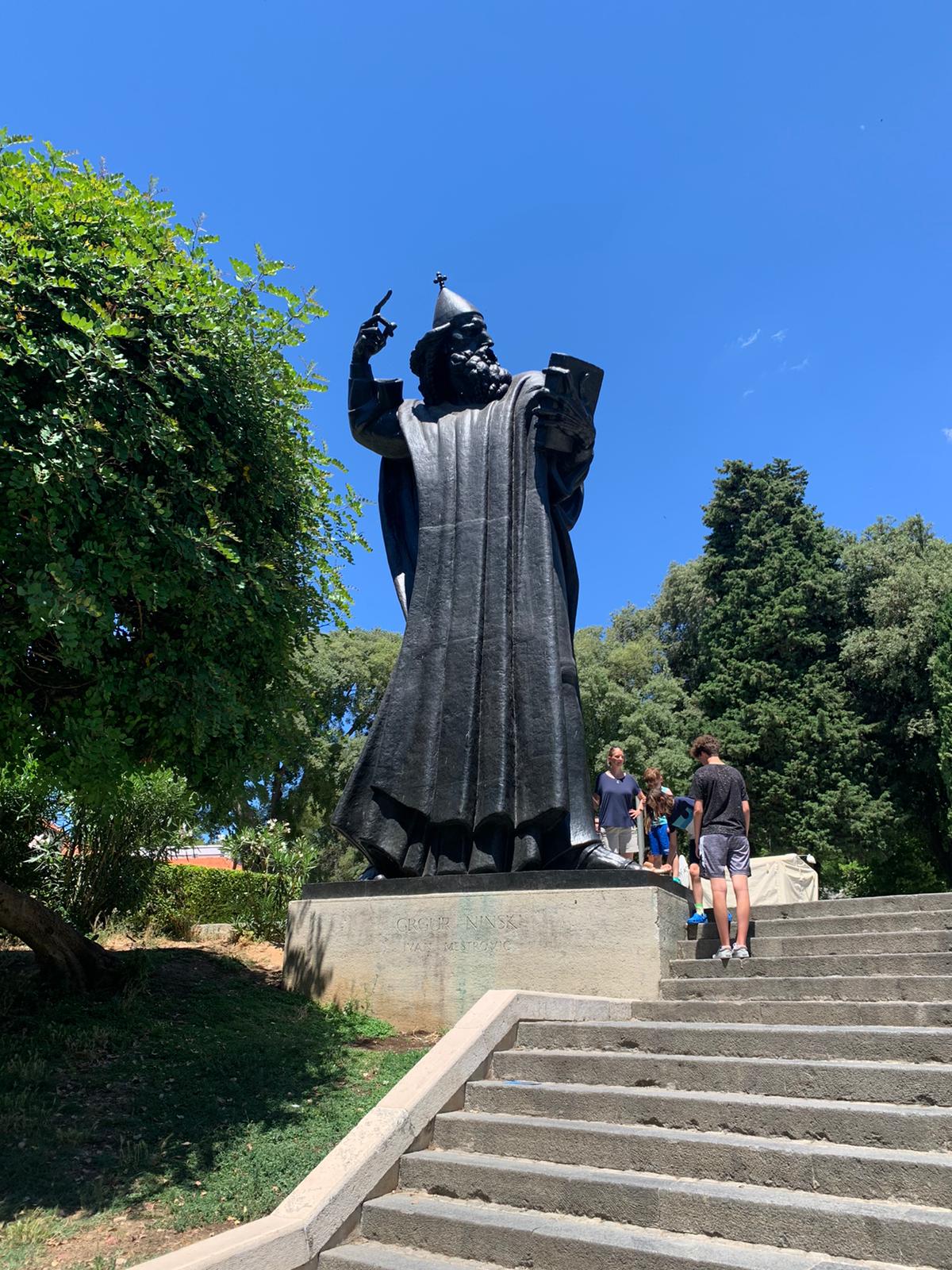
That year, as a tourist guide, I found myself several times in Jupiter’s Temple in Split – without Meštrović’s John the Baptist. It is not the same to show guests a photograph instead of an imposing sculpture. The feeling of emptiness was real. Nevertheless, I proudly explained where it was and why it was there – in Paris, side by side with Rodin.
Meštrović and Rodin first met in Rome. In his letters, Meštrović addressed Rodin with deep respect – My dear Master. This expression clearly testifies to the initial relationship of a student to a teacher, but also to the awareness of the greatness before him.
However, this relationship evolved into a dialogue over time. Rodin recognized in Meštrović a sculptor of strong expression and his own sculptural language – an artist who, as he wrote, “pours life into stone.” The relationship of teacher and student grew into a relationship of equal interlocutors.
The permanent exhibition of the Musée Rodin included a Portrait of Rodin, which Meštrović created in Rome in 1914. It is a homage to the teacher, but also a self-aware, authorial interpretation. Meštrović did not imitate – he contemplated and shaped, retaining his own sculptural identity.
In front of the museum entrance, the Well of Life in plaster was also placed, a work created when Meštrović was only twenty-two years old, a strong testament to the early maturity of his talent.
His presence at the Musée Rodin clearly showed that Meštrović was not there as a guest, but as an equal participant in the European sculptural canon. His works stood alongside Rodin’s – without the need for additional explanation.
Under the impression of devastating wars, Rodin strongly opposed the destruction of monuments and works of art, emphasizing that they belong not only to individual nations but to all humanity.
The two giants of the 20th century left us an immense legacy. Their works are entrusted to all of us – to preserve, understand, and pass on with full responsibility.
Anita Birimiša